
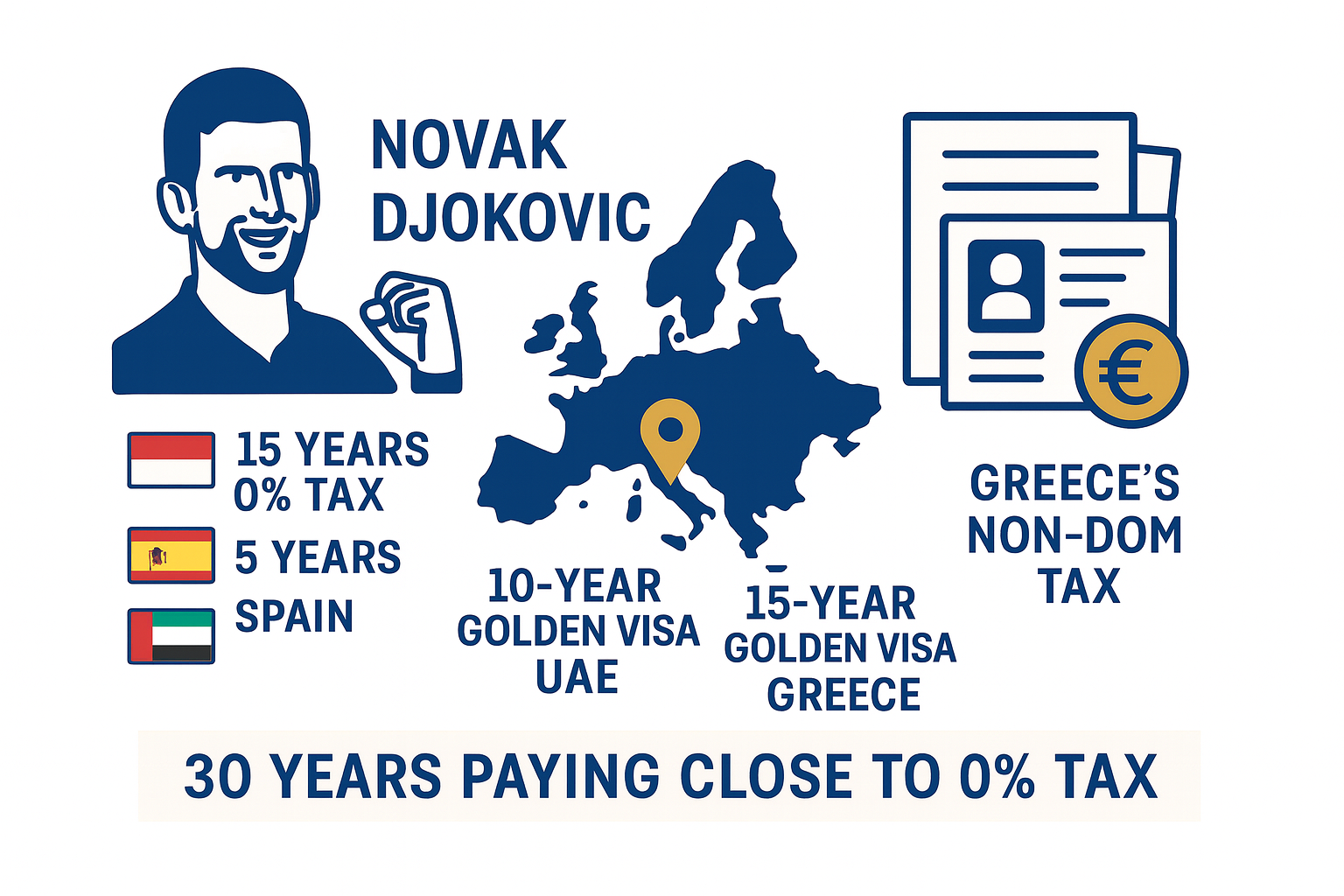
Tax optimization through strategic residency is one of the most powerful but least discussed wealth-building tools available. When done correctly and legally, it's transformative. When done carelessly, it's a legal nightmare.
Let me start with a reality: Novak Djokovic's tax strategy isn't magic. It's systematic planning. He's simply been more intentional about where he lives than most people. And the good news? The principles apply to regular people too, not just professional athletes earning hundreds of millions.
The Monaco Model: The Classic Foundation
Monaco has been the gold standard for high-income earners for decades. The reason? No income tax for residents. Zero. None. This isn't a loophole—it's codified in Monaco's law and recognized internationally.
Here's how it works: Once you establish residency in Monaco, your worldwide income is not taxed by Monaco. This is fundamentally different from most countries, which tax their residents on global income. But there's a requirement: genuine residency. You must spend a certain number of days physically in Monaco annually.
The traditional approach involves:
- Moving to Monaco as your primary residence
- Registering with local authorities
- Establishing yourself as a resident
- Reorganizing your income sources to operate through Monaco
For high-income individuals, this can save millions annually. For Djokovic at his peak earning years, Monaco's 0% income tax created enormous savings. The catch? Monaco has a high cost of living. Your accommodation, lifestyle, and daily expenses are premium. You're paying in a different way.
The Spain Strategy: 10 Years of Non-Dom Benefits
Spain introduced a non-dom tax regime in 2015 that's often overlooked. Here's what it means for new residents: You can claim non-resident status for income-tax purposes for up to 10 years if you become a resident in Spain and haven't been a Spanish resident for the previous 10 years.
This means:
- Spanish-source income is taxed normally
- Foreign-source income remains untaxed during those 10 years
- After year 10, you convert to normal resident status
For someone like Djokovic with investments globally, foreign-source income (dividends, rental income from properties outside Spain, etc.) experiences zero tax for 10 years. Spanish income still gets taxed, but most of his income comes from his career, which he can structure to minimize Spanish tax.
The benefit? For international investors and business owners, this is significant. Ten years with no tax on foreign income is powerful.
The UAE Advantage: No Personal Income Tax Ever
The United Arab Emirates has no personal income tax. Period. For residents of the UAE, worldwide income is not taxed. This is why Dubai and Abu Dhabi have become magnets for international talent.
Djokovic's 10-year golden visa in the UAE represents a second phase of his strategy. After Monaco and Spain (combined 20+ years), he could establish UAE residency and continue paying effectively zero income tax.
The catch? You must genuinely reside in the UAE. You can't just claim residency while living elsewhere. Companies are increasingly checking this. But if you can physically be in Dubai for a meaningful portion of the year, it works exceptionally well.
The Greek Golden Visa Plus Tax Residency
Greece's new scheme (as of 2023) offers something interesting: A 15-year non-dom status combined with their golden visa program. This means:
- €250,000 real estate investment (or €500,000 outside Athens)
- Residency visa for up to 2 years (renewable)
- Non-dom tax status for foreign-source income for 15 years
- Only €100,000 annual flat tax on foreign income
For Djokovic, this might be a long-term play. A 15-year non-dom status in Greece provides guaranteed tax certainty. You know exactly what you'll pay for 15 years.
The Geography Arbitrage Element
Here's something crucial that most people miss: You can actually sequence your residency.
- Monaco (0% tax) - Years 1-15 during peak earning years
- Spain (10-year non-dom, 0% foreign tax) - Years 15-25, foreign income remains untaxed
- UAE (0% income tax) - Years 25-35, continue tax-free status
- Greece (15-year non-dom) - Later years, locked-in €100k/year flat tax
The key insight? Your residence and tax residency status can be strategically sequenced. Djokovic has essentially structured 30+ years of minimal taxation through thoughtful, legal residency planning.
The Legitimate Strategy Framework
The IRS, HMRC, and other tax authorities don't love aggressive tax planning, but they accept legal residency-based planning. Here's why it's legitimate:
- Substance over Form - You're not just claiming residency; you have genuine ties to the location
- Double-Tax Treaties - Most countries honor non-dom and tax residency rules when legally established
- Transparency - Governments know about these regimes; they're official policy
- Compliance - If structured correctly with proper documentation, it's fully compliant
What This Means For You
You don't need Djokovic's income to benefit from residency-based tax planning. Someone earning €150,000+ annually from global sources can significantly benefit from these strategies.
Practical applications:
- Remote workers earning from non-local sources can benefit from non-dom status
- Investors with significant dividend income can substantially reduce tax burden through strategic residency
- Business owners with international operations can structure residency to minimize tax exposure
- Digital entrepreneurs with global clients can utilize non-dom regimes across multiple countries
The Implementation Reality
Here's what most people miss: These strategies require time and planning. You can't just move to Monaco tomorrow and claim zero income tax. You need:
- Legal residency establishment - Proper documentation, government registration
- Genuine presence - Actually spending time in your claimed residency location
- Professional guidance - A tax advisor familiar with international tax law
- Advance planning - Typically 6-12 months of preparation before the move
The good news? If you plan ahead, these strategies are entirely accessible. The costs of establishing residency (legal fees, accountants, documentation) are easily outweighed by tax savings for high-income earners.
The Tax Authority Perspective
Tax authorities globally are aware of these strategies and largely accept them. Why? Because they're legal. What they don't accept is:
- Claiming residency without physical presence
- Fraudulent documentation
- Misrepresenting tax residency status
- Using shell companies deceptively
If you're genuinely moving and establishing real residency, you're operating within the rules.
My Honest Take
Strategic residency-based tax planning is one of the most underutilized and legitimate wealth-building tools available. Most people think it's either:
- Illegal (it's not, when done correctly)
- Only for billionaires (it's not)
- Too complicated (it takes work, but it's manageable)
The reality? It's a proven framework used by successful entrepreneurs, investors, and high-income earners worldwide.
If you're genuinely earning significant income from global sources, spending a few thousand on professional tax planning could save you hundreds of thousands annually. That's a return on investment that's hard to ignore.
Djokovic didn't create this system—he simply understood it and executed it strategically. You can do the same.